The PACT Pattern: How to Build a System Around AI
Stop treating AI like a magic chat box. Project, Artifacts, Context, Tasks - a simple pattern for building a real system around the work you actually do.
Big Idea
Most people use AI like a vending machine. You walk up, type a question, grab the answer, walk away. Next time you come back, it has no idea who you are or what you were doing.
That works fine for “write me a tweet.” It falls apart the moment you try to do real work - the kind that spans days, has moving parts, and needs to remember what happened yesterday.
So here’s the thing I kept running into: the AI was smart, but the work around it was a mess. I was copy-pasting context into every chat. Losing track of decisions. Re-explaining the same project for the tenth time.
The fix wasn’t a better prompt. It was a better system. I call it PACT.
Project. Artifacts. Context. Tasks.
That’s it. Four pieces. Let’s walk through them.
Quick note before we dig in: this isn’t a thing I dreamed up last week. My first scratch notes on this are dated October 6, 2025 - I’ve got the doc to prove it - and I’ve been chipping away at it ever since. Call it eight months and change of testing this against real client projects, watching what broke, and tightening it up. So this isn’t theory. It’s the pattern I actually reach for now.
P is for Project
Everything starts with a Project. Not a chat. Not a one-off question. A Project.
A Project is the container for a real outcome. “Automate the invoice system for Plumbers Inc.” “Build the grant-writing workflow.” Something with a beginning, a middle, and a done.
This sounds obvious, but it’s the part everyone skips. When you don’t name the Project, the AI has nothing to anchor to. Every conversation floats off on its own. Name the Project and suddenly there’s a home for everything else - the notes, the decisions, the next steps.
The person closest to the problem usually already knows the Project. They just never wrote it down.
A is for Artifacts
Artifacts are the stuff the work produces. Meeting notes. A draft quote. A Google Doc. A spec. The actual output you can point at and say “that’s what we made.”
Here’s where AI quietly changes the game. In the old way, artifacts lived in your head or scattered across ten apps. Now the AI can generate them, save them, and hand them back to you later.
In one of my projects the AI took raw meeting notes and turned them into a clean, structured doc - then saved it to Google Drive and linked it right back to the Project. Next week I didn’t have to remember any of it. I just opened the Project and there it was.
That’s the magic move: artifacts don’t disappear. They pile up in the right place, attached to the right Project, ready to be reused.
C is for Context
Context is what the AI knows before you say a single word.
This is the difference between an assistant who’s been with you for months and a stranger off the street. The stranger needs everything explained. The assistant already knows the client’s name, the tech stack, the budget, the weird thing the customer asked for last Tuesday.
You build Context on purpose. Tags, notes, the history of the Project, the people involved. You feed it in once, and from then on the AI shows up already knowing.
And here’s the part I love: Context can move. You can store it in a doc, in a database, in a RAG system - and shift it around as your setup grows. The point isn’t where it lives. The point is that the AI never starts from zero again.
Most of the frustration people have with AI is really a Context problem. They’re mad the model “forgot,” but they never gave it a place to remember.
T is for Tasks
Tasks are the next actions. The small, concrete steps that move the Project forward.
“Draft the quote.” “Organize the meeting notes.” “Send the follow-up questions.” Each one small enough to actually finish, each one tied back to the Project.
This is where it stops being a chat and starts being work getting done. The AI can draft the task, estimate it, do the first pass, and check it off - while you stay the human in the loop making the calls. AI does the heavy lifting. You decide what’s good.
Tasks are also your honest scoreboard. Backlog, in progress, done. When you can see the Tasks, you can see the Project. No more “wait, where did we leave off?”
How the four fit together
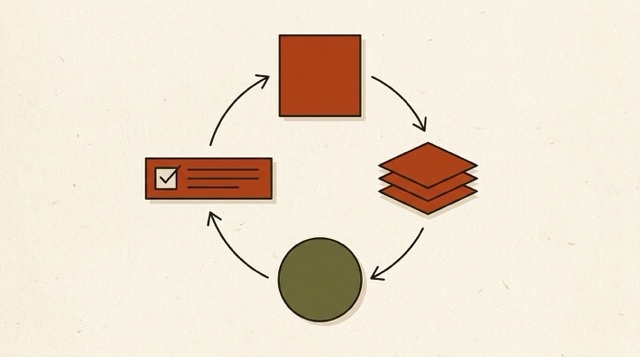
Put them in a line and the system clicks:
- The Project gives you a goal.
- Tasks break that goal into steps you can finish.
- Doing the tasks produces Artifacts you can keep.
- All of it feeds back into Context so the next round is smarter than the last. Round and round. Every loop, the AI knows more, you re-explain less, and the work actually compounds instead of evaporating into a hundred dead chat windows.
That’s the whole trick. You’re not building a smarter AI. You’re building a system around the one you already have.
Where to start
You don’t need a database or a fancy setup to begin. You need one real Project.
Pick something you’re actually working on this week. Name it. Write down the next two or three Tasks. Drop in whatever Context you’d normally explain out loud. And when the AI makes something useful - a doc, a draft, a plan - save it as an Artifact instead of letting it scroll away.
Do that for one Project and you’ll feel the difference fast. The AI stops being a vending machine and starts being part of the team.
Start small. One Project. Build from there.