No-Code News Roundup - Week of January 30, 2026
Google releases text to world, Anthropic and MCP Apps, Industry Trends for No-Code in 2026
Platform Updates
Anthropic — MCP Apps Launch
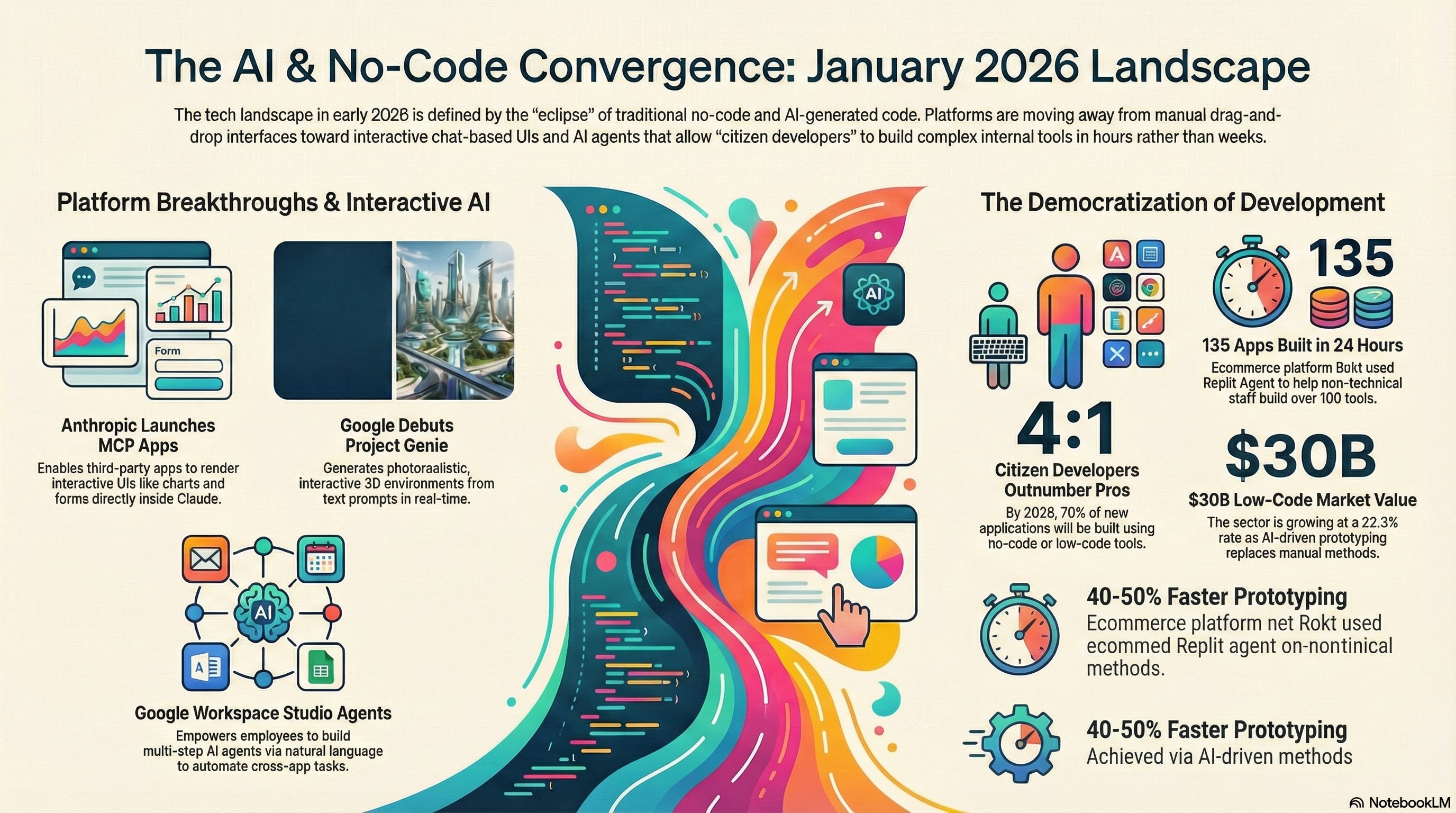
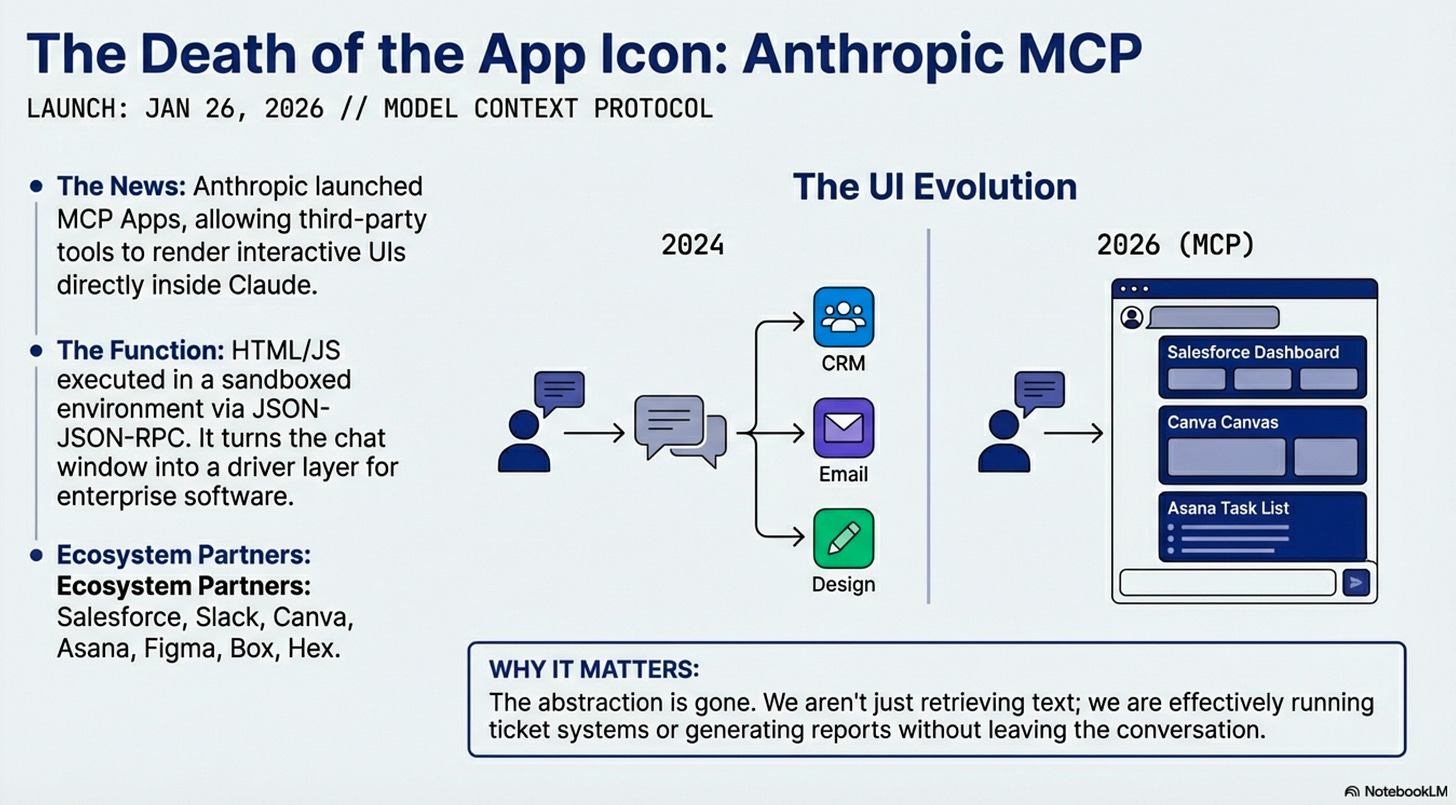
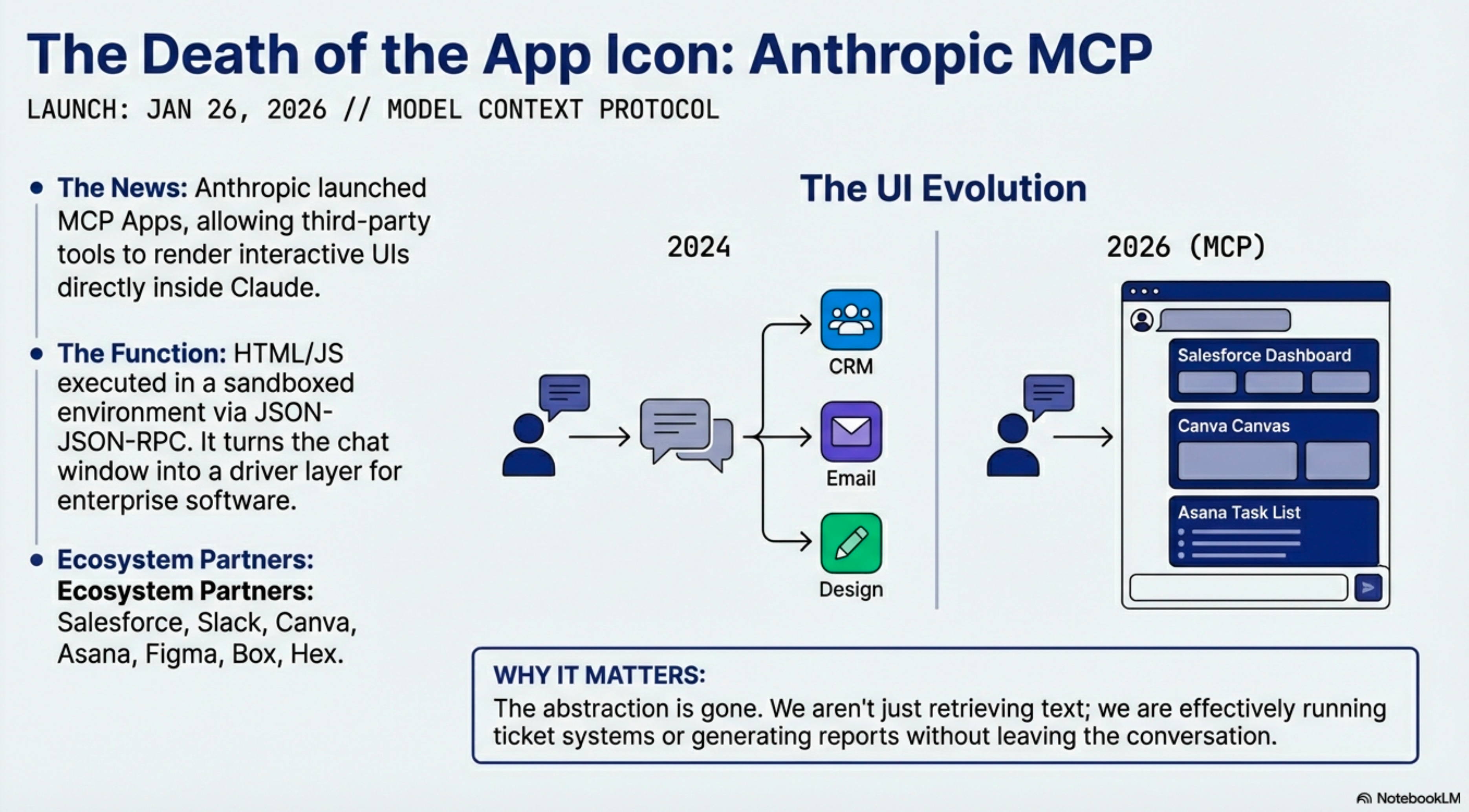
The News: On January 26, Anthropic launched MCP Apps — a major extension to the Model Context Protocol that lets third-party apps render interactive UIs (charts, forms, dashboards, buttons) directly inside Claude’s chat window. Launch partners include Amplitude, Asana, Box, Canva, Clay, Figma, Hex, monday.com, Slack, and Salesforce. Build once, works across Claude, Goose, VS Code, and ChatGPT. The architecture uses HTML/JS rendered in a sandboxed environment with JSON-RPC messaging for security. This effectively turns Claude into a platform where MCP is the driver layer.
Link: Claude supports MCP Apps — The Register
Why it matters: It’s great to see this terminology and this kind of concept coming together. There’s been a lot of buzz around the AGUI, but it’s been a little bit too abstract and hard to really connect all the dots. I saw what OpenAI was trying to do a couple months back with these integrated apps, but it was still a little bit too proprietary. But this is a great balance of bringing together a concept, making it easier to understand and implement. So here we are now able to basically interact in chat with our applications. This is pretty powerful. For example, we have a ticket system we’re using and we need to kind of see what’s going on, chat with those particular items, make reports. And to do it all right here, I know you could have done it with MCPs, but now we’re making interfaces on the fly to quickly check off items and get stuff done.
[
Google — Project Genie (Genie 3)
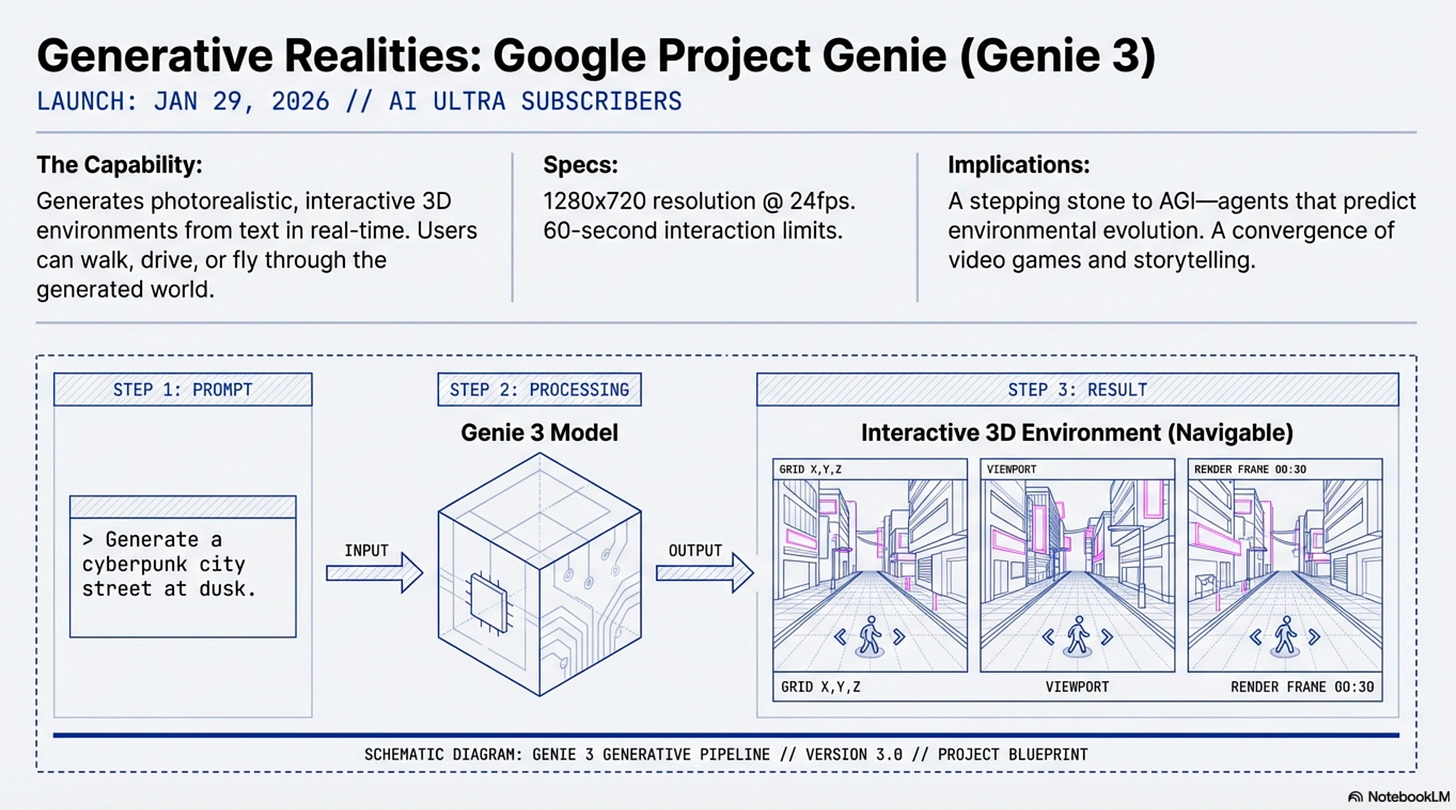
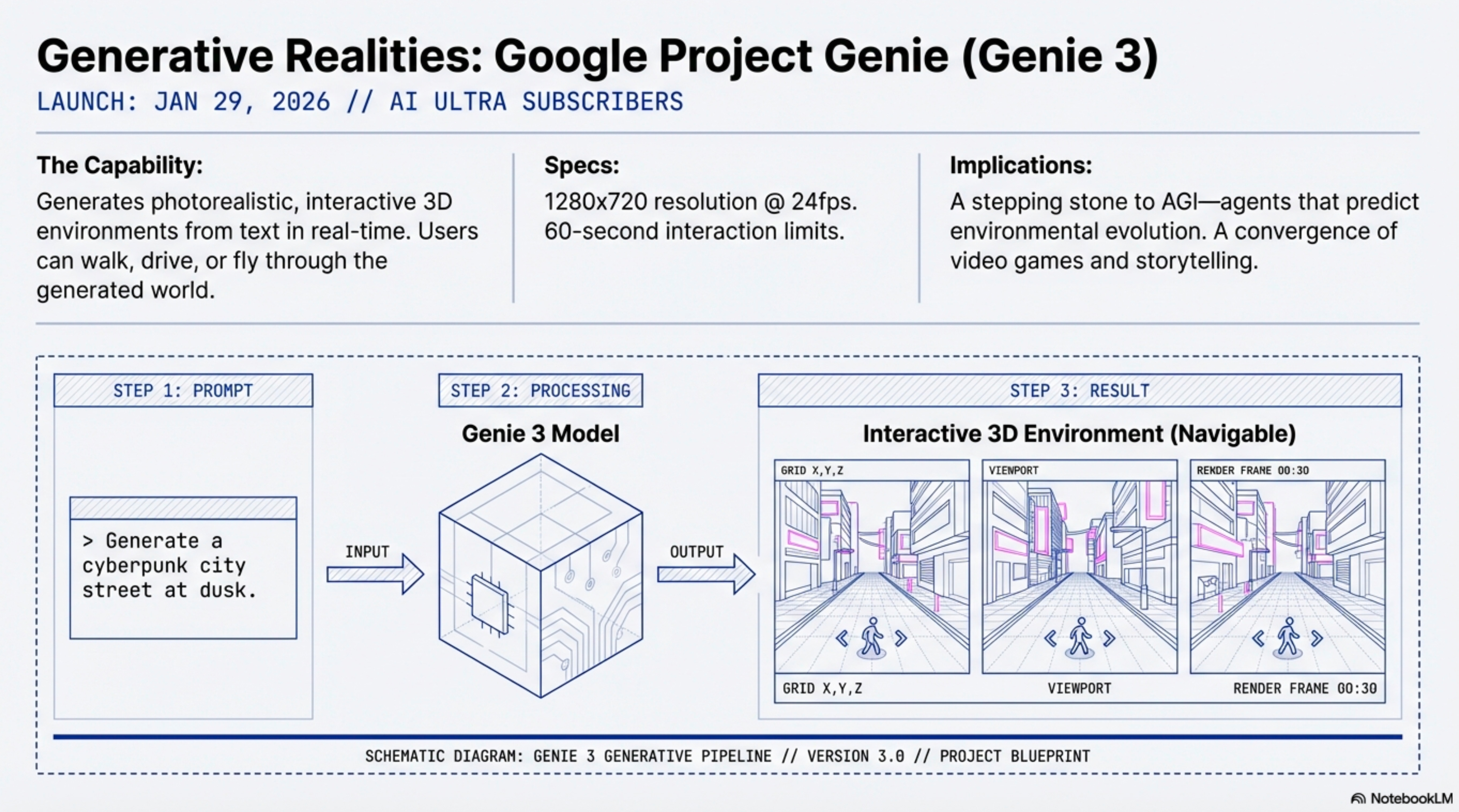
The News: On January 29, Google launched Project Genie for AI Ultra subscribers ($250/mo) in the US. Powered by Genie 3, it generates photorealistic, interactive 3D environments from text prompts in real time — not static 3D snapshots. Users can sketch worlds, explore them (walking, driving, flying), and remix them. Resolution is 1280x720 at up to 24fps, limited to 60-second interactions. Google positions this as a stepping stone toward AGI — agents that can predict how worlds evolve and how actions affect them.
Link: Project Genie — Google Blog
Why it matters: 🤯 This is big news. I’ve thought of this years ago where if we could control real live looking video games, why can’t those video games be like directing a play or a scene? And here we are now able to generate scenes and control them. So now you can imagine this being used for B-roll and other storytelling abilities and more. I mean, it’s just going to keep going. But not only can you generate imagery and video, but then kind of move it around to maybe tell a story. Pretty exciting stuff. I still think we’re inches away from breaking into a new form of storytelling. So I’m really excited to see where this goes.
[
Google — Workspace Studio Rolling Out
The News: Google Workspace Studio continues rolling out to Rapid Release domains (Scheduled Release pushed to February). The no-code AI agent builder lets any employee create multi-step agents via natural language — agents that scan emails, extract info, trigger notifications, generate content, and coordinate across apps, all powered by Gemini 3. Limits: up to 100 agents per customer, 20 steps max per agent. Early results: 20 million automated tasks in the last month; Kärcher reports 90% reduction in drafting time.
Link: Workspace Studio — Google Workspace Blog
Why it matters: I mean, here we are again. I mean, Google is just bringing it all together, most importantly with context. I don’t know how anyone’s going to catch up with them, honestly, besides integrations like MCPs. But their context is so there, your email, your documents, your spreadsheets, so much that they definitely have the leg up. Being Google, they might never bring it to total fruition because they sometimes lack that kind of customer feedback cycle or drive that seems to help them finish things or take it to the next level. But we’ll see. I mean, this is exciting. And it’s just interesting to see them just bringing it all together. I really didn’t know they had a chance two years ago.
Noloco (from misc.md)
The News: January newsletter: redesigned workspace layout, easier container customization via drag-and-drop sidebar (community-requested), faster charts, updated Nola AI assistant with minimize/expand controls, new Product Education Manager Diana Kirby, and an upcoming n8n integration to match their existing Make and Zapier integrations.
Link: Noloco
Why it matters: Just a quick shout out to this tool. It’s really way ahead of a lot of other tools I’ve been looking at for UI builders. So just more features they’ve added for easier building experience, more enjoyable. So just give it a look.
AI & Local LLM Updates
[
Local LLM Landscape — January 2026
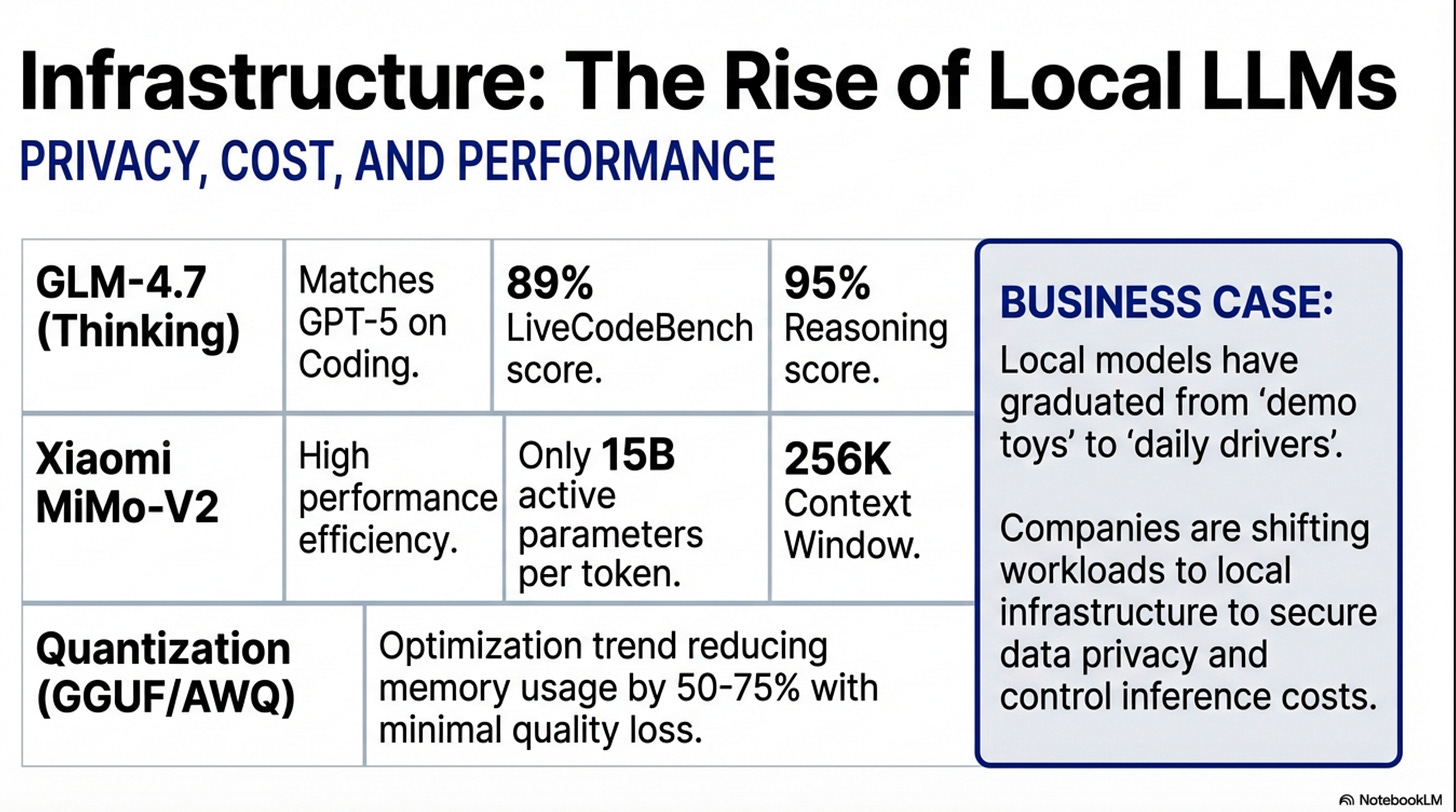
The News: GLM-4.7 (Thinking) leads open-source with 89% LiveCodeBench and 95% reasoning, matching GPT-5 on coding. Xiaomi’s MiMo-V2-Flash: 309B MoE with only 15B active parameters per token, 256K context, hybrid thinking mode. Qwen2.5 dominates downloads (8.85M+ for the 1.5B-Instruct alone). The consensus: local LLMs have gone from demo to daily-driver. Quantized models (GGUF, AWQ) cut memory 50-75% with minimal quality loss.
Link: Best Open Source LLMs January 2026
Why it matters: I mean, it’s available. You’ll see it on my local benchmark testing that it is doing a good job for business benchmarks. So this GLM 4.7 model is worth running and using for your business needs. If you’re focused on privacy and cost, it’s give it a go. https://localaibench.com/
Community Examples & Interesting Finds
Rokt — 135 Apps in 24 Hours with Replit
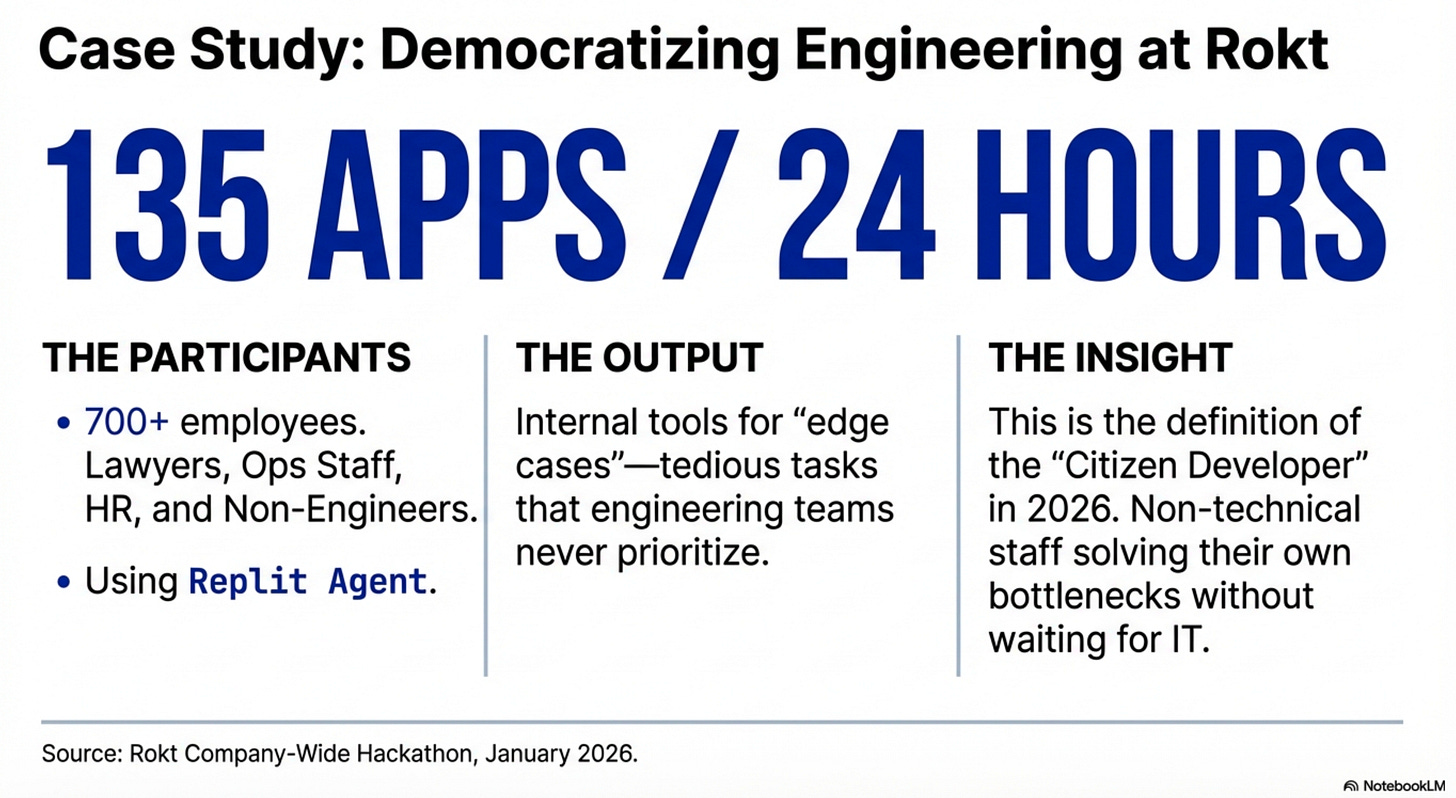
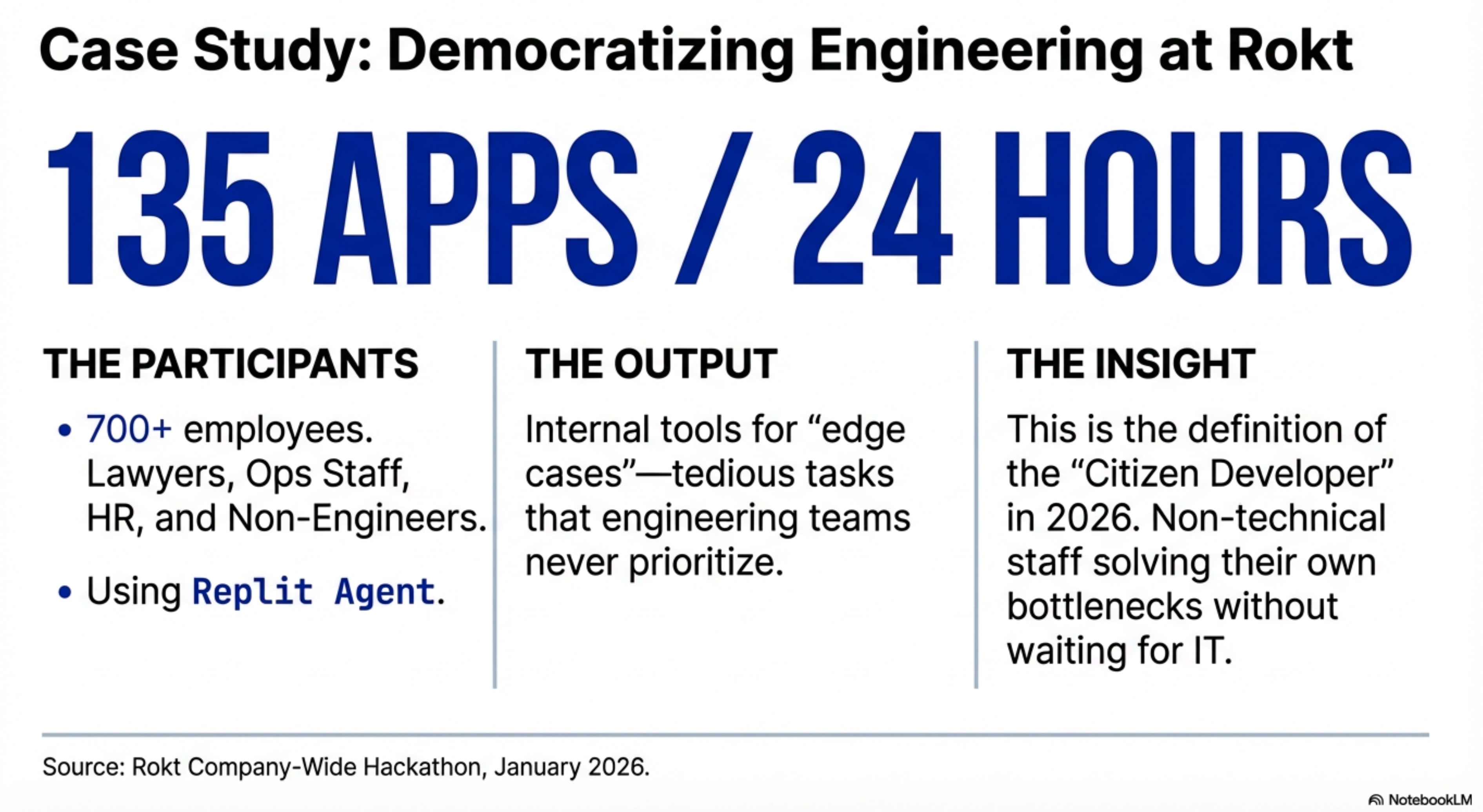
Innovation: Global ecommerce platform Rokt ran a company-wide hackathon where 700+ employees (technical and non-technical) built 135 internal applications in 24 hours using Replit Agent. Lawyers, ops people, and non-engineers building their own tools. Replit itself is nearing a $9B valuation.
Link: How Rokt built 135 apps in 24 hours — Replit
Why it matters: This is a great article and I mean I know it’s just kind of a sub article but I’m gonna try and bring in more of these because I think this is the most important part is the practical application when these tools enable non-technical people to solve edge — what would you call it? Solve basically to solve the things that are slowing them down, to solve those tedious tasks that they don’t want to do over and over again, to help them maybe do different work because they’re not doing that other work that takes them so much time but is tedious. To see success stories like this is really cool.
[
ETRI Open-Sources TANGO (No-Code ML Framework)
Innovation: South Korea’s ETRI released TANGO, an MLOps tool that automatically generates neural networks via no-code and automates deployment. Aimed at domain experts who lack neural network knowledge — build and deploy ML models without writing code.
Link: No-code machine learning development tools — TechXplore
Why it matters: This one is a bit over my head, but I did a little bit of research with AI on it, basically talking to Gemini. And it’s clear that this is one step closer to the thing that I think is most important in all these stories is giving the domain expert, the business person, the doctor who knows how to read the x-rays, the machinist that knows how to QA the metal, the ability to create the, in this case, a neural network to help with AI and automation. So this particular no-code framework, it was pretty fascinating. Still a little bit abstract to me, but to enable someone who’s an expert in their business domain to generate a neural network is pretty amazing.
GitHub Trending This Week
[
January 27, 2026 Snapshot
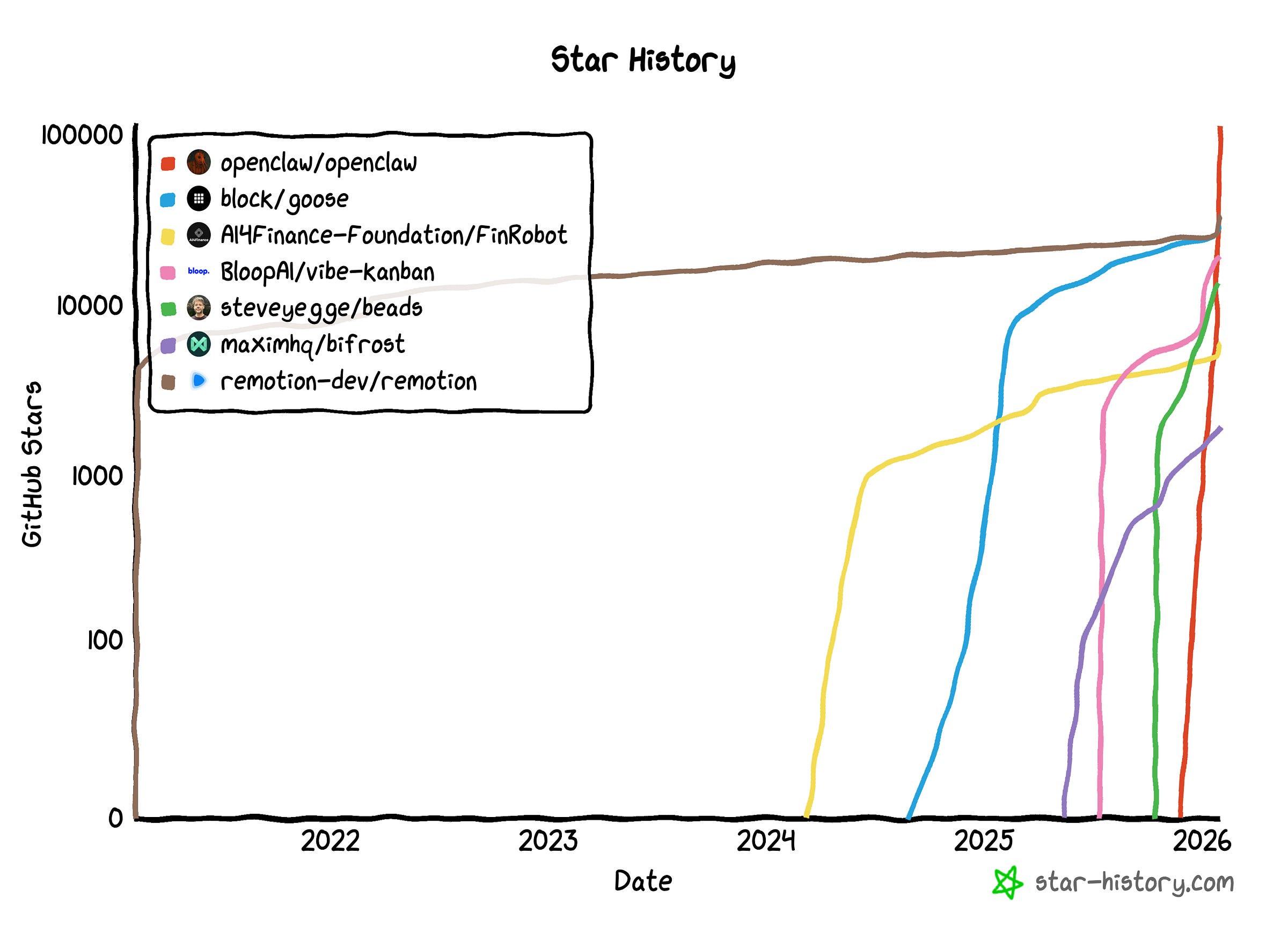
What’s Hot: Remotion crossed 32K stars (programmatic video creation becoming foundational infrastructure). mlx-audio surged +1,233 stars in a day — developers urgently need Apple Silicon-optimized AI tools for local, private processing. Specialized vertical AI agents are replacing general-purpose single agents.
Why: Really interesting library to make video or animations or kind of like the day flash came out. Give it a look, remotion. It’s a lot of buzz about it. I tried it. It’s nice. It’s really empowering. But again, you have to have a creative idea. That’s the dirty part.
Trending Repos:
Goose (Block/Square) — Open-source AI agent that goes beyond code suggestions: install, execute, edit, and test with any LLM. Running locally. https://github.com/block/goose
FinRobot (AI4Finance-Foundation) — 5,771 stars. Open-source AI agent platform for financial analysis using LLMs. Vertical-specific agents are the next wave. https://github.com/AI4Finance-Foundation/FinRobot
Vibe-Kanban — Orchestration platform managing multiple AI coding agents from a unified Kanban board. Moving from chat-based to task-based project management. https://github.com/BloopAI/vibe-kanban
Beads (Steve Yegge) — Git-backed memory system for AI coding agents. Solves the problem of agents forgetting context. https://github.com/steveyegge/beads
Bifrost — Fastest LLM gateway (50x faster than LiteLLM), adaptive load balancing, 1,000+ model support. https://github.com/maximhq/bifrost
Why it matters: Just trying to keep an eye on these trending github repositories just so You know you can see what’s out there for example beads I’ve been trying to think about memory for some of my AI workflows and why am I not using that or like bitfrost were With one with Pfizer they had trouble with some LLM stuff and we could use that as a gateway So just keeping an eye on what’s there to use for day-to-day workflows
Industry Trends — No-Code in 2026
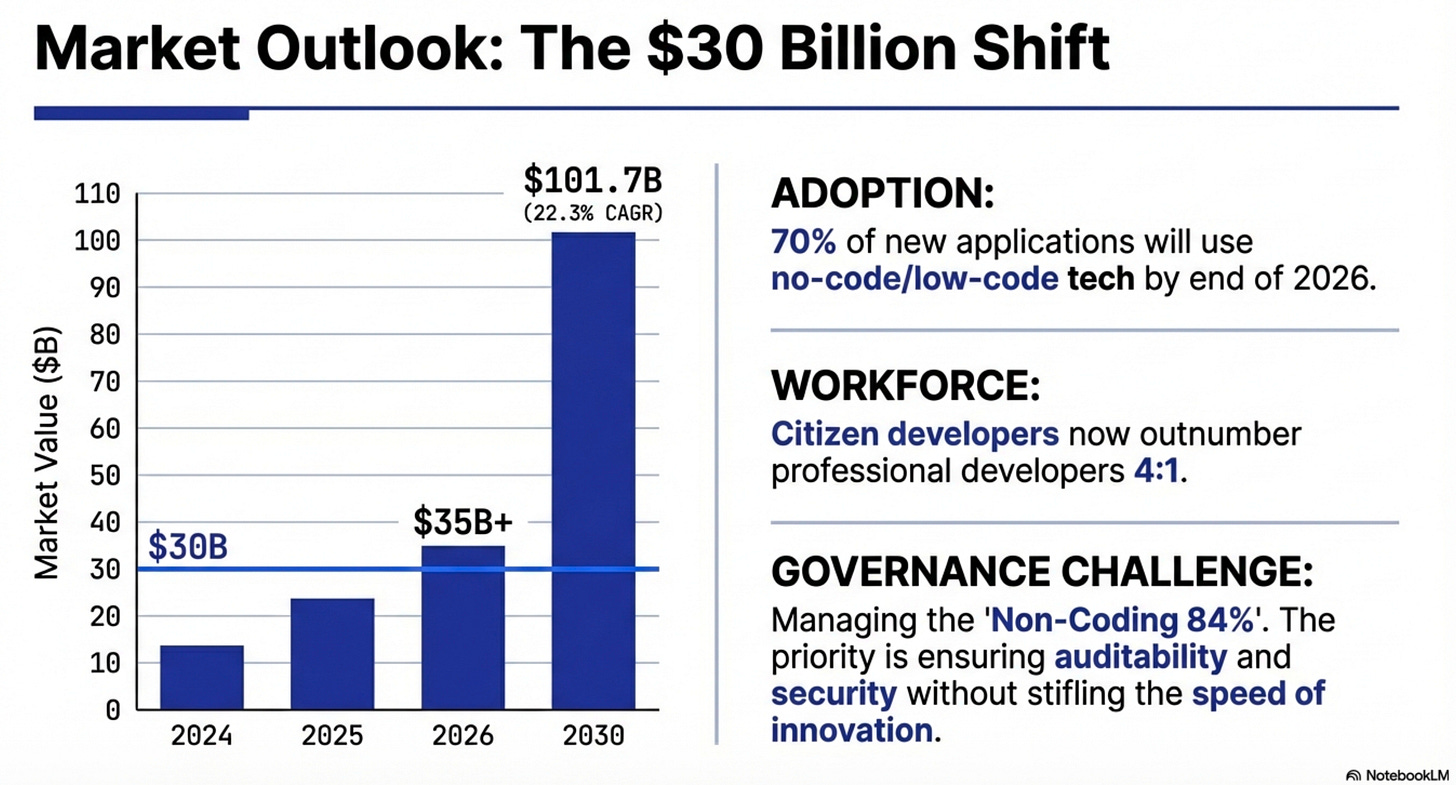
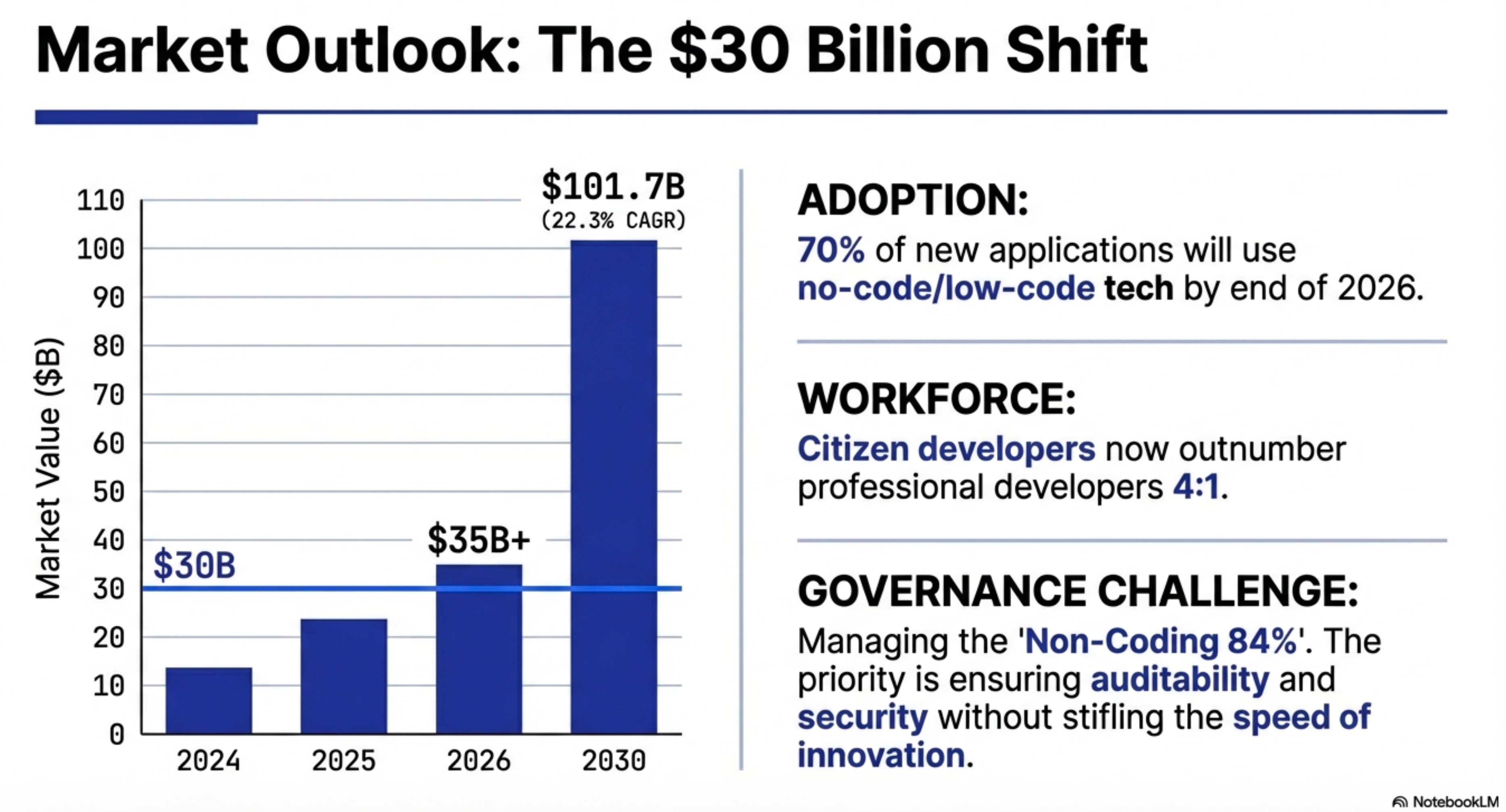
The Numbers: Gartner forecasts the low-code market to exceed $30B in 2026. The sector is growing at 22.3% CAGR through 2030, projected to reach $101.7B. 70% of new apps will use no-code/low-code by 2026. Citizen developers now outnumber professional developers 4:1.
The Shift: Visual drag-and-drop interfaces are declining — AI-driven platforms that create apps from functional descriptions are replacing them. AI-driven prototyping is now 40-50% faster than traditional no-code methods.
What Winners Look Like: The next wave compresses the “non-coding 84%” without creating governance debt: secure connectivity, auditability, approvals, role-based access, and safe reuse across teams.
Links:
2026 Low-Code/No-Code Predictions — DEVOPSdigest
No-Code Statistics 2026 — Integrate.io
Why it matters: why it matters is it shows we are heading into a new paradigm. It’s the merging of no code and AI vibe coding. So it’s kind of the mix of frameworks context in non-developer, non-coder needed anymore to then quickly build out many applications with just AI and prompting.
[
Internal Content — alfrednutile.info
Posts published January 30, 2026:
All About AI Automation // AI Inside #111 — Why this matters is because I was on the show, so please give it a listen.
Can Open Source LLMs Models Perform Common Business Tasks? — Why this matters is it’s a tool or a website I’m building to just show people that these AI models that are open source can do the work instead of just saying they can’t and having people say they don’t do well at abstract benchmarks. I’m just using really normal business benchmarks.
Claude Skills Aren’t Just for Claude – Here’s How to Build Them for ANY Agent — This is more of a deep dive into Claude skills and how to use them in other systems. It’s still kind of like a no-code moment. I think he gets a lot into code, but the concept could be applied to no-code and how we think of interacting with AI.
Build a Demand Forecasting & Inventory Planning Dashboard with ToolJet — Their videos are basically just not great in my opinion, they’re just kind of like sound bites, but just to hopefully get your imagination going what you could build with ToolJet.
Quick Reference Link List
Platform Updates:
AI & Local LLM:
Best Open Source LLMs Jan 2026
Community & Success Stories:
GitHub Trending & Industry:
2026 Low-Code/No-Code Predictions
Internal: